

Five Key Takeaways From PRRI’s New Survey on Political Violence in America
Americans want political leaders to play a stronger role in lowering the temperature of our political discourse

At a time when political violence is rising in the United States, PRRI’s latest survey, released last month, examines Americans’ views on the drivers of political violence, when violent actions may be justified, and which groups are most responsible for causing it. There is much to unpack in the survey results, but several findings have stayed with me in the weeks since its publication.
1. Most Americans say political leaders’ failure to condemn violent rhetoric from their own supporters contributes significantly to violence — yet deep partisan blame makes such leadership unlikely.
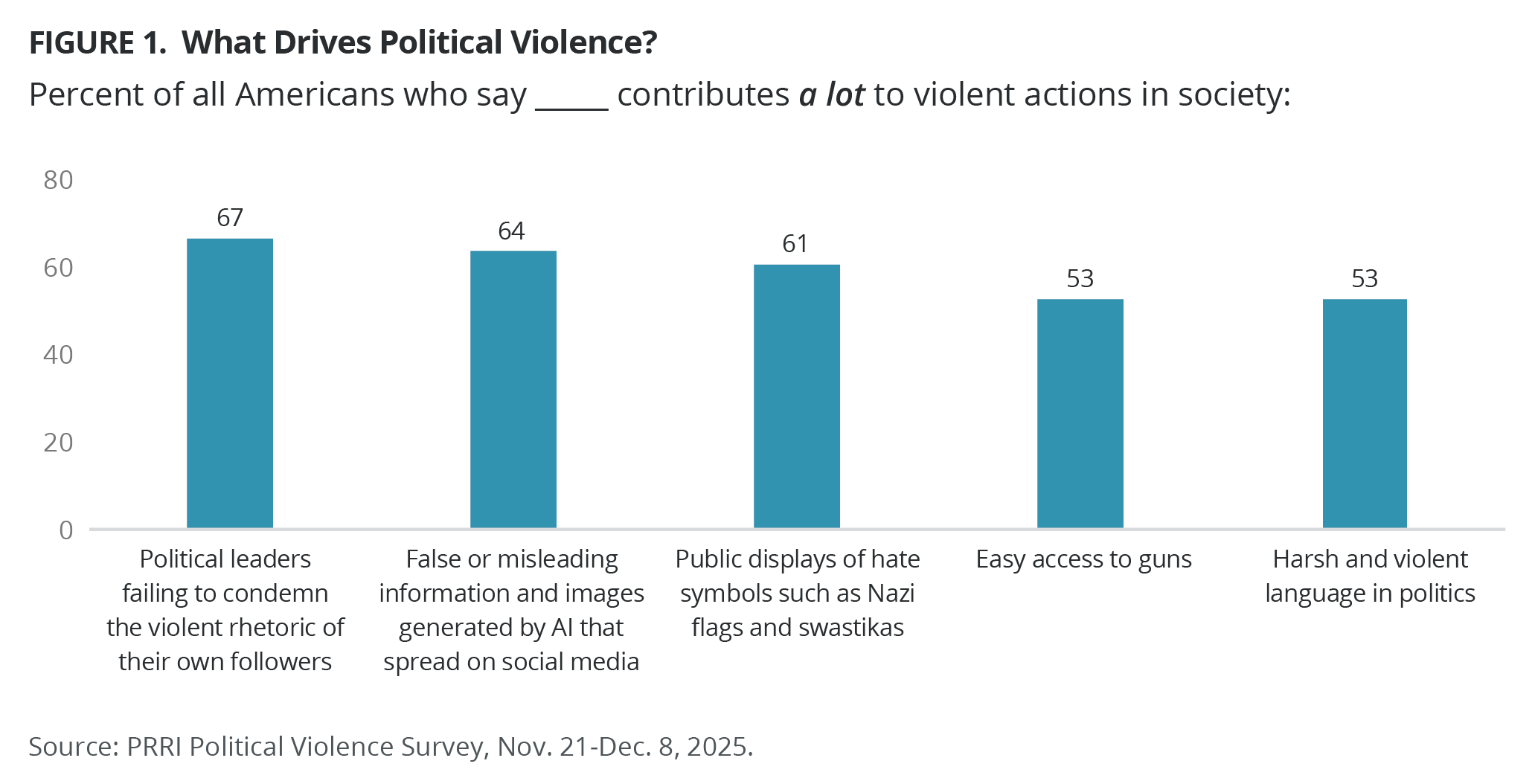
We asked Americans whether five different factors contribute a lot, a little, or not at all to violent actions in society. The leading factor was the failure of political leaders to condemn the violent rhetoric of their own followers — a view shared by strong majorities in both parties, although Democrats (80%) are 20 points more likely than Republicans (60%) to agree.
Clearly, Americans want political leaders to play a stronger role in lowering the temperature of our political discourse. Research shows that responsible leadership and calls for restraint can help reduce violence. However, this will remain difficult because partisans hold deeply entrenched views about who is responsible for political violence.
Our survey finds that Democrats overwhelmingly blame right-wing groups (73%), while Republicans blame left-wing groups (72%). These perceptions may lead some leaders to sidestep their responsibility to condemn hateful rhetoric or violent actions when they view their own side’s behavior as justified. (Of course, analysts point to strong evidence that political violence is more often committed by right-wing extremists than by left-wing actors.)
President Donald Trump presents an additional challenge. Compared with other American presidents, Trump has used more divisive and antagonistic language, particularly toward political opponents. As we saw last week, his dangerous rhetoric appears to have few bounds: Trump reposted a racist video depicting Barack and Michelle Obama as apes, imagery long used to dehumanize Black Americans. Although the video was removed after public outcry, no apology followed; the White House instead claimed the repost was the work of a staffer rather than the president himself. When the nation’s chief executive continually indulges grievances and hateful rhetoric, lowering the temperature of political discourse becomes extraordinarily difficult.
2. Concern about AI “deepfakes” and political violence reflects broader and growing anxiety about the technology’s negative consequences.
Our finding that 64% of Americans believe false or misleading AI-generated information and images circulating on social media contribute significantly to violence in society reflects a growing recognition of the risks AI poses to democracy. AI has become increasingly pervasive in daily life. While much of the AI-generated content now flooding social media feeds may be harmless or absurd, the rapid spread of fake images and deepfakes that fuel political disinformation is contributing to political instability and has the potential to incite political violence.
Moreover, research suggests that AI-driven disinformation may be particularly harmful to women political leaders and perpetuate racism, reinforcing what GW professor Spencer A. Overton calls “ethnonationalism by algorithm.” Without regulation, Overton argues, AI chatbots will increasingly be used to “sow disinformation, racial distrust, and civic disengagement.” It is not hard to see how its increased usage may help soften the ground for acceptance of political violence.
3. Just 6 in 10 Americans believe public displays of hate symbols such as Nazi flags and swastikas contribute to violence in society; Democrats are more likely to agree than independents or Republicans.
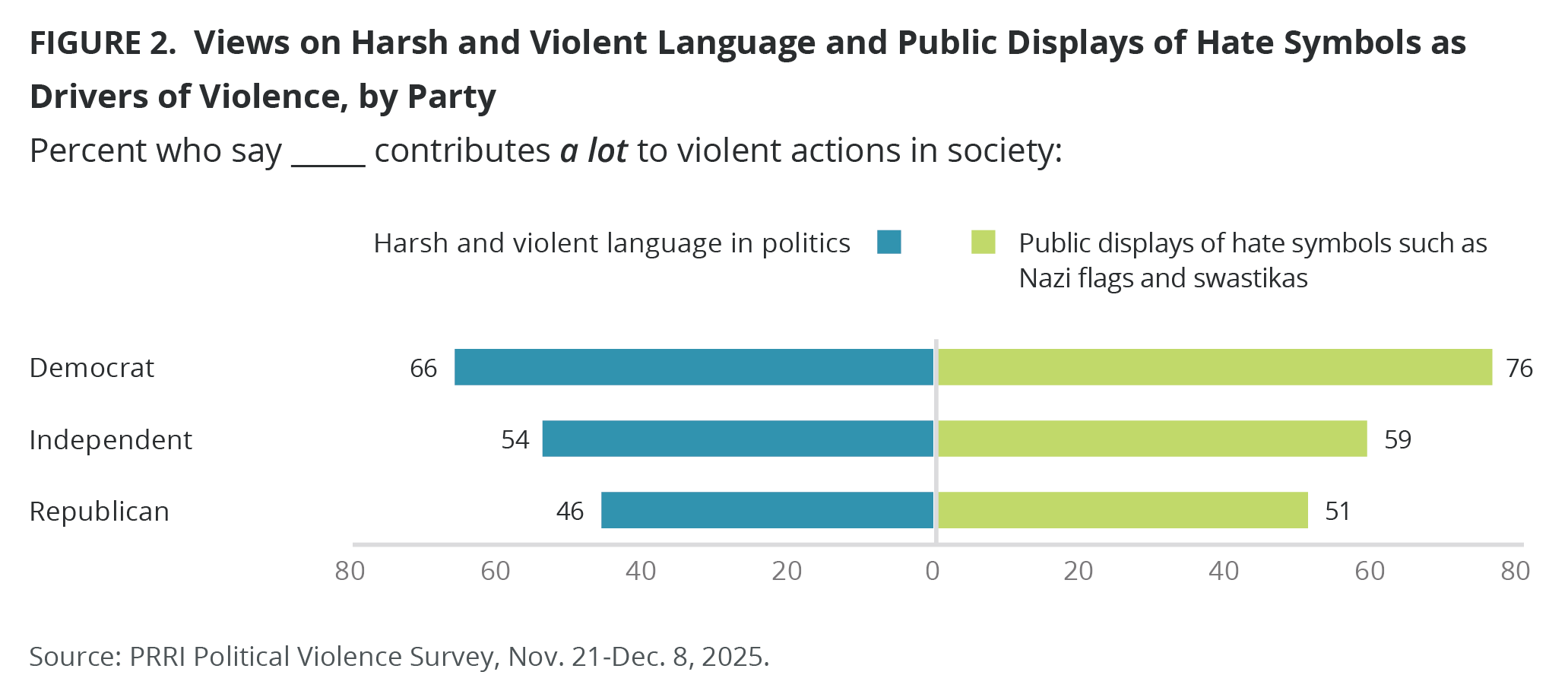
Given the history of Nazi propaganda and the current rise of documented antisemitic acts occurring in the United States, including the arson and attempted murder of Pennsylvania Governor Josh Shapiro last April during Passover, the finding that only 61% of Americans believe that these public displays of hate contribute to violence, to me, is surprisingly low. The partisan divides are stark: 76% of Democrats believe these symbols fuel political violence, compared with just 51% of Republicans.
In the past year, tensions have emerged among Republican leaders over right-wing antisemitism and free speech. While some Republicans have strongly condemned the growing amplification of antisemitic views within some segments of the far right, others have not. In fact, when the popular MAGA podcaster Tucker Carlson decided to interview avowed white supremacist Nick Fuentes, known for praising Hitler, questioning the Holocaust, and advancing the Great Replacement Theory, some conservative leaders, including Donald Trump, defended Carlson. Last fall, POLITICO leaked private messages from dozens of Republican activists in several states involved in the Young Republican National Federation, laced with racist, misogynistic, and pro-Nazi rhetoric. GOP leaders in those states largely denounced these activists and pressured many to resign. Yet other notable Republican leaders, including Vice President JD Vance, downplayed the language in the leaked messages as “edgy joke-telling.”
Returning to our survey findings, when nearly half of one party’s members view swastikas or the Nazi flag — symbols inextricably linked to genocide and domestic terror — as “edgy” or disconnected from actual violence, the threshold for radicalization lowers. This normalization creates a permissive environment where extremist rhetoric can transition from private chat rooms to acts of violence. Creating more public awareness about the impact of such public displays and having civic leaders forcefully denounce them is essential.
4. Younger Americans may be more susceptible to political violence appeals.
Our survey shows that very few Americans (7% or less) believe violent or hostile actions, such as assault, doxxing, property damage, or even murder, are ever justified to advance their side’s political goals. Only 12% agree that imprisoning a political opponent without a trial is acceptable for political ends if that person poses a clear danger to the country.
In fact, large majorities soundly reject the idea that such specific actions are acceptable — roughly 3 in 4 Americans completely disagree that most of these measures are ever acceptable. Yet I’m struck by the over/under 50 divide, with older Americans far more resolute in their opposition to such hostile or violent acts. Americans under the age of 50 are showing more permissive attitudes toward political violence, particularly the country’s youngest adults, which is something we should be monitoring.
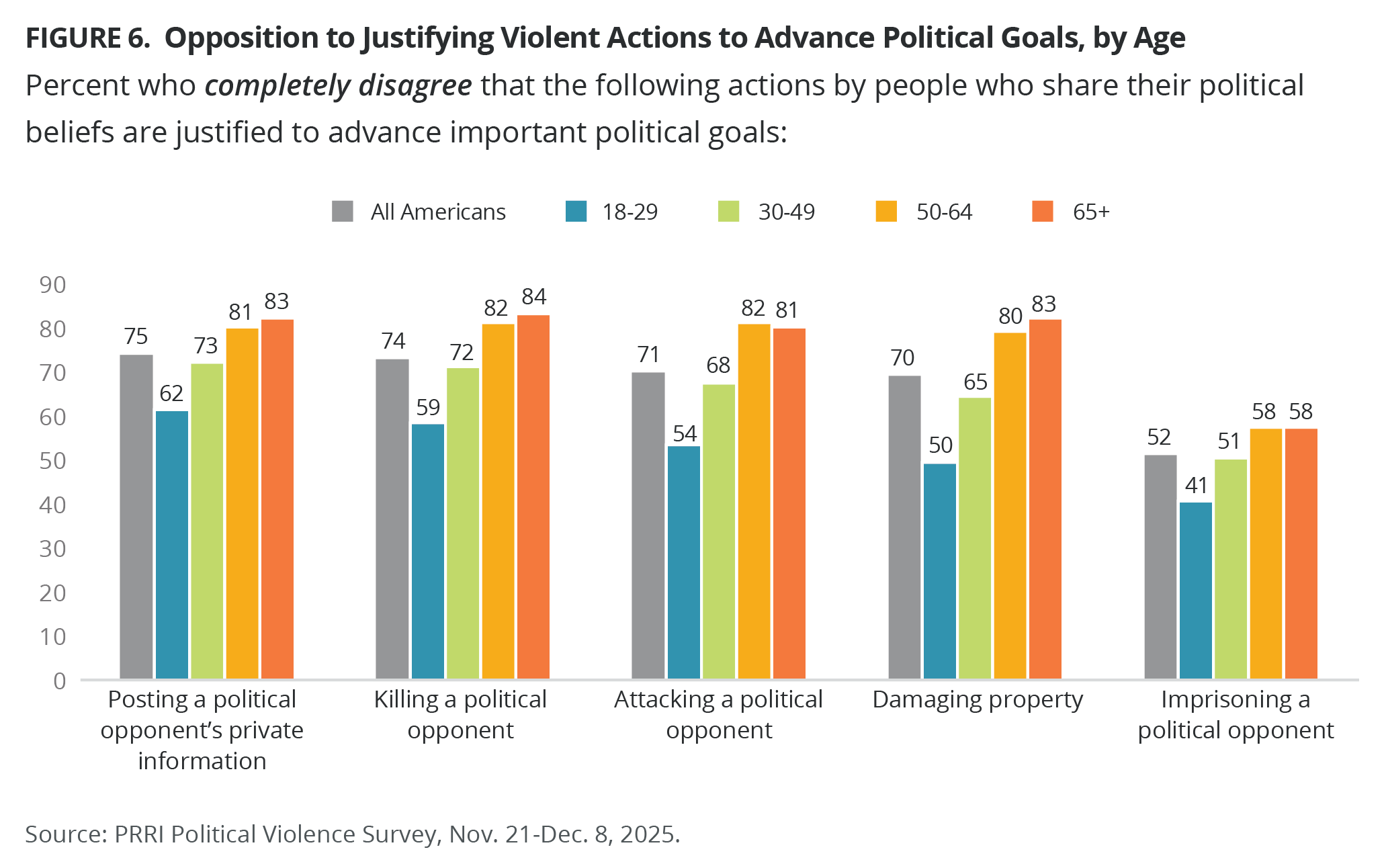
These findings echo recent polling, such as the Harvard Youth Poll released last fall, which found that nearly 40% of Americans aged 18-29 — across party lines — believe that political violence may be acceptable under certain circumstances. Similarly, polls taken after the December 2024 shooting death of United HealthCare CEO Brian Thompson show that roughly 4 in 10 young people believe that actions taken by Luigi Mangioni, now under trial for his murder, were justified.
I think there are multiple explanations at play for these findings. PRRI and others consistently find that mistrust in the major institutions in society among Gen Z Americans in society is far higher than among older Americans. Zoomers are also less likely to believe that the American dream — that if you work, you can get ahead — applies to them. Chronically online, Gen Zers get less information from legacy media sources and often rely on visual platforms for news, potentially making them more susceptible, or at least more numb, to violent appeals online. Building a political and economic system that works for younger Americans is essential to help support democracy.
5. Most Americans view protesters as making our country better.
To end on a more positive note, I do find some cause for optimism in our survey, particularly given recent events in Minneapolis and other cities that the Trump administration has targeted in its immigration crackdown. We find continued strong support for Americans’ constitutional right to protest. Specifically, most Americans (68%) agree that “when Americans speak up and protest unfair treatment by the government, it always makes our country better,” compared with 29% who disagree. Agreement has increased since 2015 (63%), when the question was first asked. While there is a strong partisan divide here, a solid majority of Republicans (56%) agree with this sentiment, compared with 82% of Democrats.
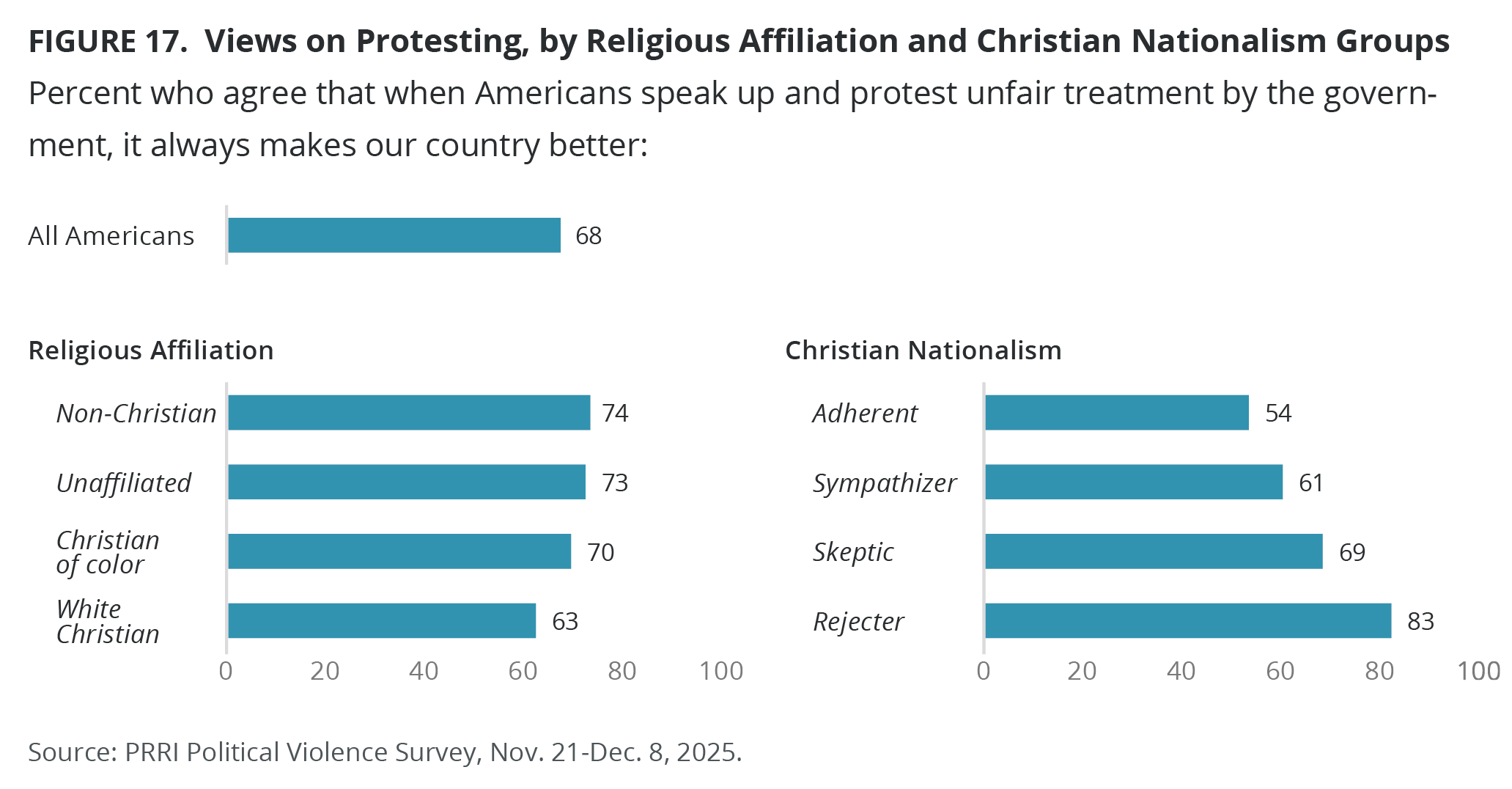
Seeing how Americans across religious traditions responded to this question also gives me hope for the future of our democracy, as we find that most people of faith remain committed to this essential First Amendment right. Even a majority of Americans who qualify as Christian nationalism Adherents (the 1 in 10 who are the most likely to exhibit authoritarian views) still believe that protesting unfair government treatment makes our country a better place.
To learn more, read PRRI’s full survey report: Political Violence in America: Public Perceptions, Polarization, and Accountability